
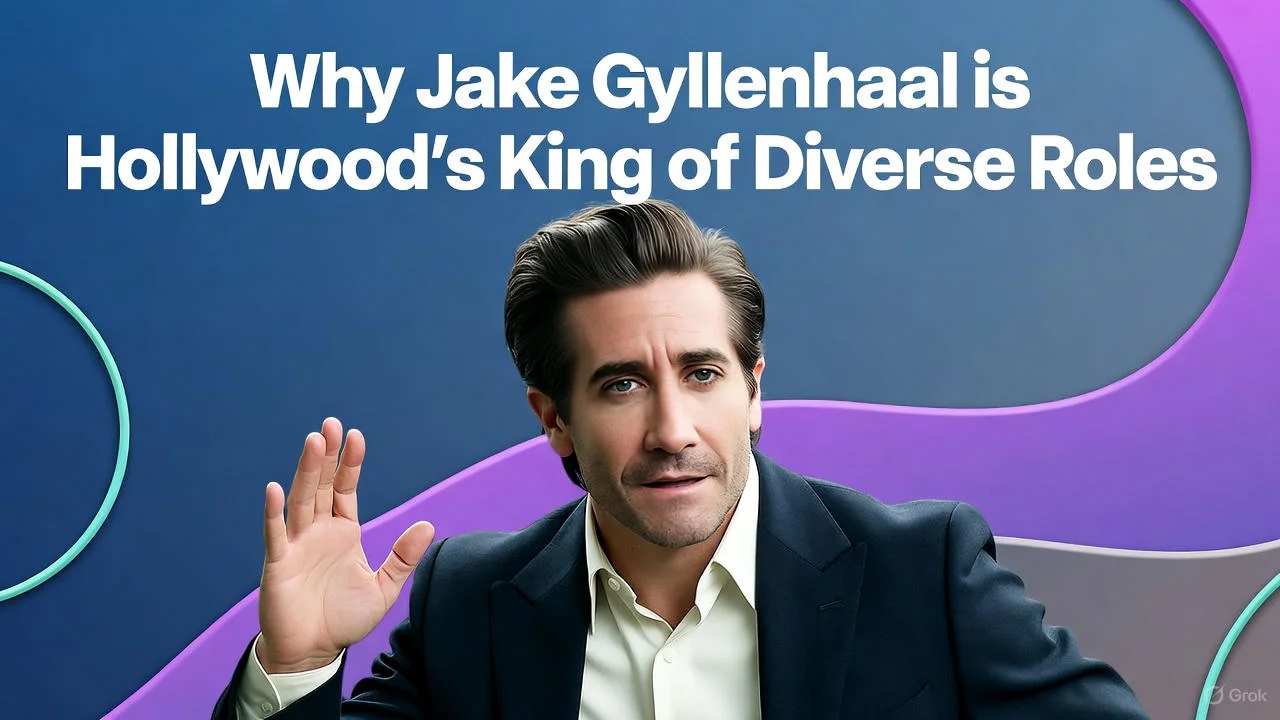
Few actors in modern Hollywood embody versatility quite like Jake Gyllenhaal. From emotionally charged indie dramas to chilling psychological thrillers, from romantic leads to complex antiheroes, Gyllenhaal has carved out a career that defies easy categorization. What makes him stand out is not just the range of roles he takes on, but the way he inhabits each character physically, emotionally, and psychologically so fully that audiences often forget they’re watching the same actor.
Gyllenhaal’s career is a masterclass in balance. He’s worked with some of the greatest directors of our time, including Ang Lee, Denis Villeneuve, David Fincher, and Dan Gilroy, while also starring in mainstream blockbusters like The Day After Tomorrow and Spider-Man: Far From Home. His choices reflect a rare commitment: the pursuit of challenging, layered characters that expand his artistic range, even when they come at the expense of safe, commercial roles.
In this article, we’ll dive deep into why Jake Gyllenhaal is hailed as Hollywood’s “King of Diverse Roles.” We’ll look at his early beginnings, his breakthrough performances, his psychological thrillers, his action films, his stage work, and his enduring legacy as one of the most fearless performers of his generation.
Early Career: From Indie Darling to Rising Star
Jake Gyllenhaal’s path to stardom began long before he became a household name. Born into a filmmaking family, his father a director, his mother a screenwriter, and his sister Maggie Gyllenhaal an acclaimed actress, Jake seemed destined for the screen. Yet his rise wasn’t instant; it was built on carefully chosen roles that showcased his raw potential and hinted at the fearless versatility that would later define him.
October Sky (1999): The First Breakthrough
Gyllenhaal’s breakout role came at just 18 years old in October Sky. Playing Homer Hickam, a small-town boy inspired by the launch of Sputnik to pursue rocketry against his father’s wishes, Gyllenhaal displayed a sincerity and emotional openness that instantly set him apart from other young actors of the time. The film became a sleeper hit, and critics praised his ability to portray earnest ambition without slipping into cliché.
Donnie Darko (2001): Cult Classic Credibility
Only two years later, Gyllenhaal cemented his reputation as an indie darling with Donnie Darko. In this haunting cult classic, he played a troubled teenager plagued by visions of a giant rabbit and apocalyptic premonitions. The role required a delicate balance of vulnerability, menace, and surreal humor, and Gyllenhaal delivered with uncanny precision.
What’s remarkable is how Donnie Darko demonstrated the range Gyllenhaal possessed at such a young age. While October Sky presented him as a wholesome, all-American dreamer, Donnie Darko revealed a darker, more complex side, earning him cult icon status and establishing his reputation for gravitating toward unconventional, risk-taking projects.
A Pattern Emerges
Even in his early career, a clear pattern emerged: Jake Gyllenhaal refused to be typecast. While many young actors of the early 2000s were swept into teen comedies or romantic fluff, Gyllenhaal chased characters that demanded more roles that challenged audiences to see him as more than just a heartthrob.
This boldness in role selection would become a defining trait of his career, setting the stage for his transformation into one of Hollywood’s most dynamic and unpredictable performers.
Romantic Dramas and Emotional Range
Jake Gyllenhaal is not only a master of psychological intensity and indie grit; he has also proven himself to be one of the most emotionally versatile actors in romantic dramas. His performances in love stories are never superficial. Instead, they reveal complex inner lives, capturing both vulnerability and passion with striking authenticity.
The Good Girl (2002): Subtle Vulnerability
Opposite Jennifer Aniston in The Good Girl, Gyllenhaal played “Holden Worther,” a shy, disillusioned young man who begins an affair with a married woman. While the film is more of an offbeat indie than a sweeping romance, Gyllenhaal’s quiet intensity and awkward sincerity gave the character depth. It was one of the first examples of how he could bring emotional rawness even to understated roles.
Brokeback Mountain (2005): A Career-Defining Turn
Perhaps no film showcases Gyllenhaal’s emotional range more powerfully than Brokeback Mountain. As Jack Twist, opposite Heath Ledger’s Ennis Del Mar, Gyllenhaal embodied the yearning, joy, and devastating heartbreak of forbidden love in 1960s Wyoming.
Jack Twist could have easily been played with melodrama, but Gyllenhaal instead brought a nuanced tenderness. His chemistry with Ledger created one of cinema’s most moving love stories, and the role earned him an Academy Award nomination for Best Supporting Actor. The film cemented his reputation as an actor unafraid of vulnerability, and it remains one of his most enduring performances.
Love & Other Drugs (2010): Romantic Charm with an Edge
In Love & Other Drugs, Gyllenhaal teamed up with Anne Hathaway to portray Jamie Randall, a charming pharmaceutical rep who falls in love with a free-spirited woman living with Parkinson’s disease. The film combined elements of romantic comedy and drama, showcasing his ability to play a character both humorous and emotionally grounded.
What stood out here was Gyllenhaal’s charisma. He balanced Jamie’s initial womanizing arrogance with a gradual transformation into a man capable of deep, selfless love. This blend of charm and emotional sincerity revealed yet another layer to his skill set.
Emotional Honesty as a Defining Trait
Across these roles, a defining trait becomes clear: Gyllenhaal approaches romance not as surface-level attraction but as an opportunity to explore the human condition in love, longing, vulnerability, heartbreak, and transformation. His willingness to fully inhabit these emotional states makes him one of Hollywood’s most compelling romantic leads, even though romance has never been his primary genre.
Thrillers and Psychological Complexity
If Jake Gyllenhaal’s early career established his versatility, it was his work in thrillers and psychological dramas that solidified his reputation as one of Hollywood’s boldest risk-takers. In these roles, Gyllenhaal leans into intensity, often portraying characters consumed by obsession, paranoia, or moral ambiguity. His ability to carry complex narratives while keeping audiences on edge has made him a standout in this genre.
Zodiac (2007): The Quiet Obsession
In David Fincher’s Zodiac, Gyllenhaal plays Robert Graysmith, a San Francisco cartoonist who becomes consumed by the mystery of the Zodiac Killer. Unlike many thriller protagonists, Graysmith isn’t a cop or detective; he’s an ordinary man drawn deeper into obsession.
Gyllenhaal’s performance is masterfully restrained. Rather than explosive emotion, he relies on subtle expressions of nervous energy, perfectly matching Fincher’s meticulous, slow-burn style. The result is a performance that anchors one of the greatest modern crime dramas.
Prisoners (2013): The Tense Investigator
In Denis Villeneuve’s Prisoners, Gyllenhaal plays Detective Loki, a cop tasked with solving the kidnapping of two young girls. What makes the role unforgettable is the quiet intensity Gyllenhaal brings to it. With his signature blinking tics, tattoos, and simmering energy, Loki feels fully realized, as though he’s lived years before the events of the film.
Balancing Hugh Jackman’s raw emotional fury, Gyllenhaal creates a portrait of controlled professionalism constantly at risk of unraveling. Critics hailed his performance as one of the best detective portrayals of the decade.
Enemy (2013): Duality and Identity
Also directed by Villeneuve, Enemy is one of Gyllenhaal’s most daring roles. He plays two characters, a history professor and his identical double, in a surreal psychological thriller about identity and repression.
The film is cryptic, filled with symbolism, and requires a lead actor capable of making its bizarre premise believable. Gyllenhaal nails the challenge, delivering two distinct yet intertwined performances. His work in Enemy highlighted his fearlessness in pursuing complex, even polarizing, material.
Nightcrawler (2014): Transformation into Darkness
Then came Nightcrawler, arguably the defining performance of Gyllenhaal’s career. As Lou Bloom, an ambitious yet morally bankrupt stringer who films violent crimes to sell to local news stations, Gyllenhaal delivered one of the most unsettling portrayals in modern cinema.
Physically transformed, gaunt, wide-eyed, and twitchy, Gyllenhaal embodied Bloom as a chilling mix of charm and menace. His relentless pursuit of success, devoid of empathy, made him a modern-day antihero. Critics compared the role to De Niro’s Travis Bickle in Taxi Driver, cementing it as a career-defining achievement.
A Master of Psychological Intensity
Taken together, these roles show Gyllenhaal’s mastery of psychological intensity. He thrives in narratives about obsession, identity, and moral compromise, bringing a level of authenticity that few actors can match. These performances didn’t just prove his skill; they made him synonymous with some of the most haunting characters in modern cinema.
Action, Blockbusters, and Physical Transformation
While Jake Gyllenhaal is best known for his nuanced performances in dramas and thrillers, he has also proven himself more than capable in the world of action films and big-budget blockbusters. What sets him apart from many action stars, however, is his refusal to settle for surface-level spectacle. Gyllenhaal approaches these roles with the same dedication to character and authenticity, often undergoing intense physical transformations to bring his performances to life.
Jarhead (2005): The Soldier’s Inner Battle
In Sam Mendes’ Jarhead, Gyllenhaal played Anthony “Swoff” Swofford, a Marine sniper deployed to the Gulf War. Unlike traditional war films that focus on battlefield heroics, Jarhead is a psychological exploration of boredom, disillusionment, and the emotional toll of military life.
Gyllenhaal’s performance captured the frustration of a soldier trained for war but left with little to do. He underwent a grueling physical regimen to embody the military physique, but it was his portrayal of Swoff’s simmering rage and existential dread that stood out. The role showed that Gyllenhaal could handle the physicality of action while keeping the emotional core intact.
Southpaw (2015): Transformation into a Boxer
Perhaps Gyllenhaal’s most dramatic physical transformation came with Southpaw, in which he played Billy Hope, a champion boxer whose life spirals after personal tragedy. Gyllenhaal gained over 30 pounds of muscle and trained intensively with professional fighters to achieve authenticity.
Beyond the physique, however, what made his performance powerful was the raw emotion he brought to the role. Billy’s journey from loss to redemption was both physically punishing and emotionally wrenching. Critics praised Gyllenhaal for elevating what could have been a formulaic sports drama into something deeply affecting.
Spider-Man: Far From Home (2019): Charisma as a Villain
Gyllenhaal’s foray into the Marvel Cinematic Universe as Quentin Beck, aka Mysterio, demonstrated his ability to thrive in mainstream blockbusters. What could have been a standard comic-book villain became something far more engaging thanks to his charismatic performance.
Initially presenting himself as a charming hero, Gyllenhaal flipped the script to reveal Beck’s manipulative, egotistical nature. His theatricality and layered performance made Mysterio one of the MCU’s more memorable antagonists. Audiences and critics alike praised how he balanced spectacle with character-driven storytelling.
The Balance of Artistry and Entertainment
Through roles like Jarhead, Southpaw, and Spider-Man: Far From Home, Gyllenhaal has proven he can excel in the action genre without sacrificing depth. Whether physically transforming his body or infusing blockbuster roles with complexity, he bridges the gap between arthouse intensity and mainstream appeal.
Stage Work and Artistic Dedication
While Jake Gyllenhaal is a celebrated film actor, his commitment to theater reveals another side of his artistry. On stage, stripped of camera tricks and editing, an actor must rely solely on presence, timing, and emotional truth. Gyllenhaal has repeatedly turned to Broadway and off-Broadway productions to challenge himself and connect with audiences in a raw, immediate way.
Sunday in the Park with George (2017): Musical Depth
One of Gyllenhaal’s most acclaimed stage performances came in the Broadway revival of Stephen Sondheim’s Sunday in the Park with George. Playing the painter Georges Seurat, Gyllenhaal showcased not only his acting but also his singing ability, surprising critics with his vocal skill and emotional depth.
The role demanded precision and vulnerability, mirroring Seurat’s obsessive drive to create art at the expense of personal relationships. Gyllenhaal infused the performance with an authenticity that critics described as “mesmerizing,” further proving his dedication to pushing boundaries.
Sea Wall/A Life (2019): Intimacy and Raw Emotion
In Sea Wall/A Life, a two-part production co-starring Tom Sturridge, Gyllenhaal performed a monologue exploring themes of fatherhood, grief, and love. It was an emotionally devastating role that required vulnerability and a willingness to connect directly with the audience.
The performance reminded critics of Gyllenhaal’s ability to hold a room with nothing but his voice and presence. Without the safety net of supporting actors or cinematic visuals, he demonstrated pure craft a testament to his range as both a film and stage actor.
Why Theater Matters to Gyllenhaal
Gyllenhaal has often spoken about how theater keeps him honest as an actor. On stage, there are no retakes; every performance is alive, unique, and vulnerable to imperfection. This risk mirrors Gyllenhaal’s career-long pursuit of challenging roles. By returning to the theater, he stays connected to the roots of acting while continually testing his artistic limits.
The Broader Impact on His Career
His stage work also feeds back into his film performances. The discipline of live theater timing, control, and deep emotional commitment is evident in the intensity he brings to screen roles. For Gyllenhaal, theater isn’t a side project; it’s an essential component of his identity as an artist.
Collaborations with Directors
One of the hallmarks of Jake Gyllenhaal’s career is his consistent collaboration with visionary directors. Rather than chasing only blockbuster opportunities, Gyllenhaal has sought out filmmakers known for depth, craft, and experimentation. These partnerships have not only defined his career but also highlighted his reputation as an actor’s actor, someone who thrives when working with directors who push him into uncharted territory.
David Fincher: Precision and Obsession (Zodiac, 2007)
Working under David Fincher in Zodiac introduced Gyllenhaal to a director renowned for his meticulous attention to detail. Fincher is infamous for demanding dozens of takes to achieve the perfect shot, and Gyllenhaal initially clashed with the process. However, the experience ultimately refined his craft, teaching him patience and the discipline of controlled subtlety.
As Robert Graysmith, Gyllenhaal learned how to portray obsession not through grand gestures but through micro-expressions and carefully measured performance. The collaboration demonstrated his ability to adapt to a rigorous creative process and deepen his psychological realism.
Denis Villeneuve Exploring Darkness (Prisoners, Enemy)
Perhaps Gyllenhaal’s most fruitful director partnership has been with Denis Villeneuve. In Prisoners (2013), Gyllenhaal’s Detective Loki was layered with quirks and tics that added humanity to the procedural role. In Enemy (2013), Villeneuve pushed him even further, tasking him with playing dual characters in a surreal psychological thriller.
Villeneuve has praised Gyllenhaal’s fearlessness, noting that he is an actor unafraid of risk. Their collaborations showcased Gyllenhaal’s ability to balance grounded realism (Prisoners) with abstract symbolism (Enemy), cementing their creative bond as one of the most fascinating actor-director pairings of the 2010s.
Dan Gilroy Transformation and Satire (Nightcrawler, Velvet Buzzsaw)
With Dan Gilroy, Gyllenhaal found a collaborator who embraced extremes. In Nightcrawler (2014), Gyllenhaal transformed into Lou Bloom, a character equal parts magnetic and terrifying. The performance earned critical acclaim and comparisons to the greatest antiheroes in film history.
Gilroy and Gyllenhaal reunited in Velvet Buzzsaw (2019), a dark satire about the art world. While the film itself received mixed reviews, Gyllenhaal’s eccentric performance as critic Morf Vandewalt was a highlight. These projects demonstrated his willingness to embrace the bizarre and grotesque when partnered with daring storytellers.
Other Notable Collaborations
- Ang Lee in Brokeback Mountain: A collaboration that demanded emotional vulnerability and subtlety, resulting in one of Gyllenhaal’s most iconic roles.
- Sam Mendes in Jarhead Mendes guided Gyllenhaal through a character study of a soldier battling existential despair, blending physical rigor with psychological complexity.
- Tom Ford in Nocturnal Animals.s As both Tony and Edward, Gyllenhaal balanced grief, rage, and fragility in a narrative blending fiction and reality.
Why These Partnerships Matter
For Gyllenhaal, working with directors isn’t just about securing big projects; it’s about entering creative partnerships that challenge and refine his artistry. His career is a testament to the belief that an actor is only as strong as the directors who push them, and Gyllenhaal has consistently sought out those challenges.
Reputation, Legacy, and Why He’s Hollywood’s King of Diverse Roles
Over the past two decades, Jake Gyllenhaal has built a career that defies simple categorization. While some actors find comfort in a specific genre, action stars, rom-com favorites, or indie darlings ,Gyllenhaal has refused to be placed in a box. Instead, he has consistently challenged himself, his directors, and his audience by embracing roles that span the emotional and artistic spectrum.
Critical Reputation
Critics often highlight his fearlessness as an actor. From his physical transformation in Southpaw to the unsettling darkness of Nightcrawler, Gyllenhaal has shown that he is willing to go to extremes in service of character. Unlike actors who rely on typecasting for security, he thrives on unpredictability every new role feels like uncharted territory.
Industry Respect
Within Hollywood, Gyllenhaal is widely respected for his professionalism and intensity. Directors like Denis Villeneuve and Ang Lee have spoken about his deep preparation and ability to elevate material. He is also known for balancing smaller indie projects with larger studio films, demonstrating an understanding of both the art and the business of cinema.
Fan Connection
Fans admire Gyllenhaal not only for his performances but also for his authenticity. Whether in interviews or on stage, he radiates a mixture of humility and intelligence that endears him to audiences. His career choices reflect a genuine passion for storytelling rather than a calculated pursuit of fame.
Why He’s Hollywood’s King of Diverse Roles
When you look across his filmography, the evidence is overwhelming:
- Romantic dramas (Brokeback Mountain, Love & Other Drugs) show his vulnerability.
- Psychological thrillers (Zodiac, Prisoners, Enemy, Nightcrawler) highlight his intensity.
- Action films (Jarhead, Southpaw, Spider-Man: Far From Home) prove his physical dedication.
- Stage work (Sunday in the Park with George, Sea Wall/A Life) demonstrates his artistic commitment.
- Collaborations with visionary directors showcase his adaptability and hunger for challenge.
This breadth of roles is why Gyllenhaal is celebrated as Hollywood’s most versatile modern actor. He doesn’t just play characters he transforms into them, disappearing so fully that audiences are left stunned by his range.
His Legacy in Progress
At just over 40, Gyllenhaal is far from done. With projects ranging from thrillers to experimental films, he continues to reinvent himself. His legacy is already secure as a chameleon-like performer who has left a mark on nearly every genre. And yet, the excitement lies in what he will do next because with Jake Gyllenhaal, audiences know to expect the unexpected.
FAQs
What is Jake Gyllenhaal best known for?
Jake Gyllenhaal is best known for his versatility, with standout roles in films like Donnie Darko, Brokeback Mountain, Zodiac, Nightcrawler, and Southpaw. He is celebrated for seamlessly moving between indie dramas, psychological thrillers, action films, and even stage performances.
Has Jake Gyllenhaal ever won an Oscar?
No, Jake Gyllenhaal has not yet won an Academy Award, but he was nominated for Best Supporting Actor for Brokeback Mountain (2005). Many critics believe his performances in Nightcrawler and Prisoners were also Oscar-worthy, highlighting him as one of the most under-recognized actors of his generation.
What are Jake Gyllenhaal’s most transformative roles?
Some of his most transformative roles include:
- Southpaw (physical transformation into a boxer)
- Nightcrawler (psychological transformation into the unsettling Lou Bloom)
- Enemy (dual roles in a surreal thriller)
- Jarhead (military discipline and intensity)
Does Jake Gyllenhaal perform in the theater?
Yes. Beyond his film work, Jake Gyllenhaal has appeared in Broadway and off-Broadway productions such as Sunday in the Park with George (2017) and Sea Wall/A Life (2019). His stage performances are praised for their emotional intimacy and authenticity.
Why do fans love Jake Gyllenhaal?
Fans love Gyllenhaal for his diverse roles, emotional authenticity, and fearless choices. He’s admired for bringing vulnerability to romantic dramas, intensity to thrillers, and charisma to action films, all while staying grounded and passionate about his craft.
What upcoming projects does Jake Gyllenhaal have?
As of now, Gyllenhaal continues to balance between blockbuster projects and smaller artistic films. He is set to star in upcoming thrillers and is rumored to be working with high-profile directors, continuing his reputation as one of Hollywood’s most adventurous actors.