
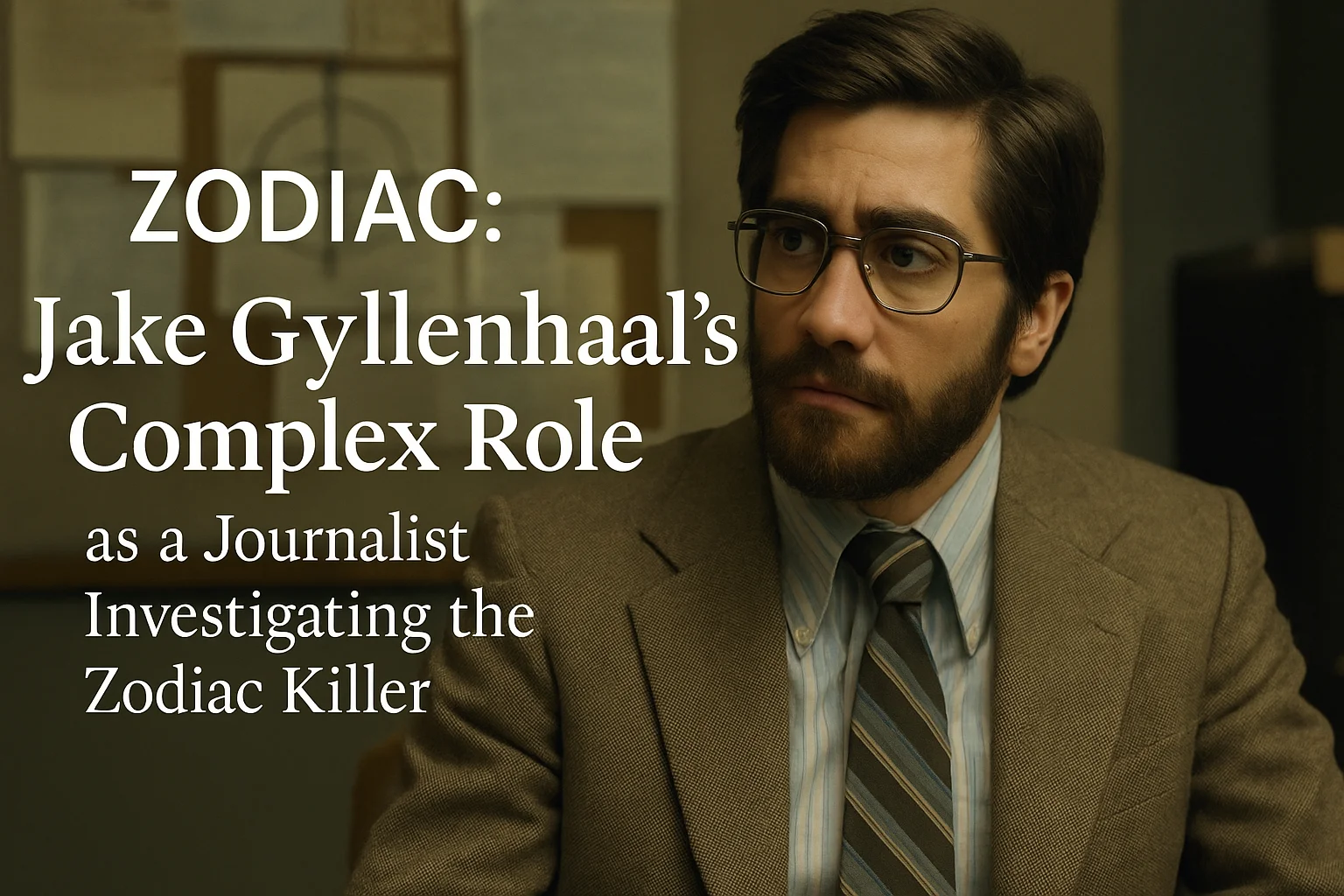
When David Fincher released Zodiac in 2007, audiences expected a chilling retelling of one of America’s most infamous unsolved crimes. What they didn’t expect was how deeply personal, haunting, and psychologically consuming the story would feel—thanks largely to Jake Gyllenhaal’s nuanced portrayal of Robert Graysmith, a cartoonist-turned-journalist obsessed with uncovering the truth about the Zodiac Killer.
Gyllenhaal’s performance stands as one of the most complex and transformative roles in his career, highlighting his ability to embody vulnerability, obsession, and moral conflict in a way that elevates the entire film. This article takes a deep dive into the significance of his role, the broader impact of Zodiac, and how it fits into both cinematic history and Gyllenhaal’s evolution as an actor.
The Real-Life Backdrop: The Zodiac Killer Case
To fully appreciate Gyllenhaal’s role, we need to understand the true events behind the story.
- The Zodiac Killer terrorized Northern California during the late 1960s and early 1970s, claiming responsibility for several murders.
- He taunted police and journalists with cryptic letters, ciphers, and phone calls, many of which were sent to the San Francisco Chronicle.
- Despite decades of investigations, the killer was never caught, leaving behind one of the most enduring mysteries in American crime history.
By centering the narrative on journalists and investigators rather than the killer himself, David Fincher emphasized the obsession and psychological toll such mysteries can take, an angle that Gyllenhaal embodied with haunting precision.
Robert Graysmith: From Cartoonist to Relentless Investigator
Robert Graysmith was not a detective or law enforcement officer. He was a political cartoonist at the San Francisco Chronicle who became increasingly intrigued by the Zodiac case.
- Initially portrayed as quiet and somewhat awkward, Graysmith is almost an outsider in the newsroom.
- Over time, his curiosity evolves into an obsession, leading him to devote decades of his life to researching, writing, and publishing books about the Zodiac.
- Gyllenhaal captures this transformation with subtlety, showing how obsession can consume not only professional identity but also personal life and relationships.
This character arc allowed Gyllenhaal to explore themes of truth-seeking, obsession, and sacrifice, making it one of the most layered roles of his career.
Jake Gyllenhaal’s Approach to Playing Graysmith
What makes Gyllenhaal’s performance stand out is his ability to ground obsession in realism. Unlike more flamboyant portrayals of journalists or detectives, his Graysmith is not dramatic but almost understated.
- Naivety and innocence: Early on, Gyllenhaal plays Graysmith with wide-eyed curiosity, almost childlike in his fascination with puzzles and ciphers.
- Gradual descent into obsession: His physicality shifts; his tone becomes more urgent, his movements sharper, his presence more intense.
- Emotional toll: Gyllenhaal doesn’t exaggerate the cost of obsession but instead portrays it through subtle exhaustion, strained relationships, and a lingering sense of isolation.
This transformation reflects Fincher’s vision of realism, where obsession doesn’t explode outward but instead eats away at a person quietly, persistently, and irreversibly.
Collaboration with David Fincher: Precision and Discipline
David Fincher is notorious for his meticulous directing style, often requiring dozens of takes for a single scene. For Gyllenhaal, this became both a challenge and an opportunity.
- Fincher’s demand for precision mirrored Graysmith’s obsessive nature, blurring the line between actor and character.
- Gyllenhaal had to find ways to convey emotion within strict technical boundaries, resulting in a performance that feels both controlled and deeply authentic.
- Their collaboration resulted in one of the most critically acclaimed performances of Gyllenhaal’s career.
The Role of Obsession: A Psychological Study
At its core, Gyllenhaal’s role is about more than investigating a killer; it’s about the psychology of obsession.
- Personal Sacrifice: Graysmith’s dedication strains his marriage and family life, highlighting the dangers of prioritizing truth over balance.
- Isolation: His colleagues and loved ones drift away as his obsession deepens, leaving him consumed by a case with no resolution.
- Ambiguity: Even after decades of investigation, definitive answers remain elusive, forcing Gyllenhaal to portray obsession not as victory but as haunting persistence.
By embracing these themes, Gyllenhaal delivers a performance that resonates with anyone who has ever struggled with the pull of unanswered questions.
Interplay with Co-Stars: Building Tension Through Relationships
Part of what makes Zodiac so effective is its ensemble cast, and Gyllenhaal’s interactions with his co-stars are critical in shaping the narrative.
- Robert Downey Jr. (Paul Avery): A seasoned journalist who initially overshadows Graysmith but later succumbs to his own self-destructive tendencies. Their contrasting arcs highlight the personal costs of chasing the Zodiac.
- Mark Ruffalo (Inspector David Toschi): A seasoned detective who provides a grounded, weary counterpoint to Graysmith’s growing obsession. Ruffalo’s pragmatic approach emphasizes the contrast between professional duty and personal fixation.
- Chloë Sevigny (Melanie Graysmith): As Graysmith’s wife, Sevigny represents the human cost of obsession, torn between supporting her husband and preserving family stability.
These dynamics enrich Gyllenhaal’s performance, situating his character within a broader tapestry of people touched by the Zodiac case.
Cinematic Techniques That Elevated the Role
Gyllenhaal’s performance is inseparable from Fincher’s directorial choices, which amplified the psychological intensity of the role.
- Muted color palette: Reflects the bleak and haunting tone of the era.
- Slow pacing: Mirrors the frustration of an unsolved investigation, amplifying the feeling of endless obsession.
- Use of silence: Scenes where Gyllenhaal’s expressions replace dialogue showcase his non-verbal mastery.
Together, these elements ensure that Gyllenhaal’s portrayal is not only about dialogue but about atmosphere and unspoken tension.
Reception: Critical and Cultural Impact
When Zodiac premiered, critics praised Gyllenhaal’s performance for its depth and restraint.
- Critical acclaim: His portrayal was lauded as one of the film’s emotional anchors.
- Cult following: Though not initially a box office hit, Zodiac has gained a reputation as one of the greatest crime thrillers ever made.
- Career milestone: For Gyllenhaal, it solidified his reputation as a serious, versatile actor capable of carrying complex psychological roles.
The Legacy of Gyllenhaal’s Graysmith
Today, Zodiac is considered a modern classic, and Gyllenhaal’s portrayal of Robert Graysmith is central to its legacy.
- It represents one of the most authentic depictions of obsession in cinema.
- It redefined what a leading man could embody in a thriller: not just toughness, but persistence, vulnerability, and psychological depth.
- It remains a pivotal role in Gyllenhaal’s career, paving the way for later performances in films like Nightcrawler and Prisoners, where he again explored the boundaries of obsession and morality.
Conclusion: A Defining Role in a Defining Film
Jake Gyllenhaal’s role in Zodiac is not just about playing a journalist; it’s about embodying the human struggle for answers in the face of uncertainty. His portrayal of Robert Graysmith reminds us that obsession can be both a driving force and a destructive weight, shaping lives in ways we may never fully understand.
By blending subtlety, vulnerability, and quiet intensity, Gyllenhaal transformed what could have been a straightforward investigative role into a masterclass in psychological acting, one that continues to resonate nearly two decades later.
FAQs
Q1: How accurate was Jake Gyllenhaal’s portrayal of Robert Graysmith in Zodiac?
His performance was praised for its authenticity, though Fincher emphasized psychological realism over strict biographical detail.
What makes Zodiac different from other crime thrillers?
Instead of focusing on the killer, it highlights the impact of the investigation on those who pursued the case, especially Graysmith.
Did Robert Graysmith ever solve the Zodiac case?
While Graysmith wrote extensively and proposed suspects, the Zodiac Killer’s identity remains officially unsolved.
How did working with David Fincher influence Gyllenhaal’s performance?
Fincher’s demanding style pushed Gyllenhaal toward meticulous precision, mirroring the obsessive nature of his character.
Why is Zodiac considered one of Jake Gyllenhaal’s best roles?
Because it showcases his ability to portray obsession and vulnerability with subtlety, marking a turning point in his career.